Games / Project story
Cake or Cursed
Find the cake hidden among five monster heads.
A short party game
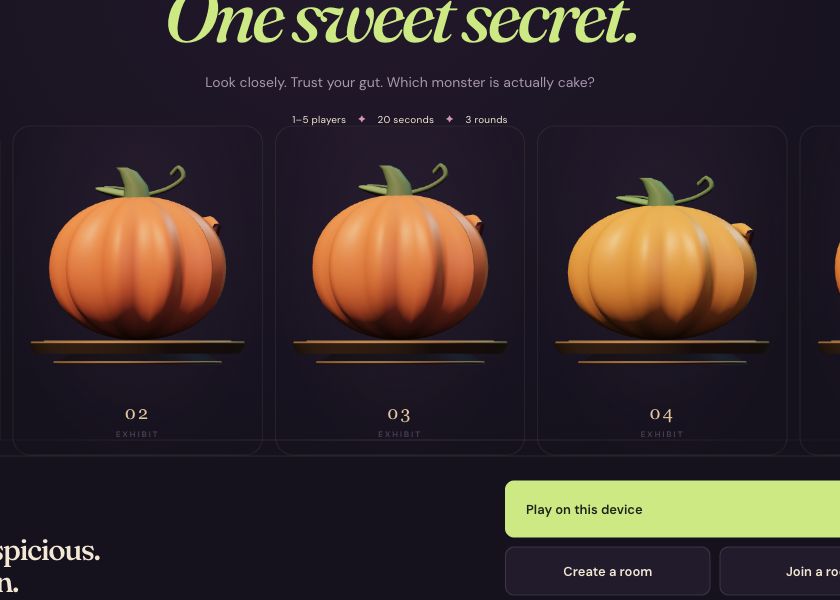
Cake or Cursed presents five monster heads and asks which one is secretly cake. Players have twenty seconds to choose. A reveal follows, and a match runs for three rounds. The game supports one to five players, either sharing one device or joining a room from separate screens.
Seven monster archetypes provide different faces for the same comparison. The heads are original procedural models rather than downloaded character assets. A single Three.js canvas draws five separate views, keeping the lineup together as a set of objects to compare.
A difference in the whole face
The documented lineup revision moved toward a stronger outlier among four smaller variations. Shape, eye spacing, color, and finish vary together. The comparison therefore involves the face as a whole rather than a single guaranteed mark that reveals the answer.
That gives the prototype a specific question to explore: how much difference makes a choice readable without making it automatic? An obvious repeated cue can become a shortcut, while arbitrary variation can leave no useful evidence to compare. The implementation controls the generated differences, but whether a particular lineup feels fair or interesting remains a judgment that automated checks cannot settle.
Rules, tests, and limits
The recorded checks cover thousands of seeded lineups, five distinct profiles, and exactly one larger outlier. Shared-device ties share the win. In a network room, correct picks use server-received timing, so connection latency can affect a tie. These are different rules for different play arrangements, not identical competitive conditions.
The testing record separates game-rule checks from rendering confidence. Browser-flow checks exercised shared-device and network play with a labeled still-image fallback when the test environment could not run live WebGL. Geometry was also rendered offline. Physical iPhone and iPad Safari performance still needs verification. Open the public prototype to try the current lineup, make a choice, and see the reveal.