CAD / Project story
Foundation Merge Prototype
A paired plan and 3D testbed for comparing room-based foundation conditions.
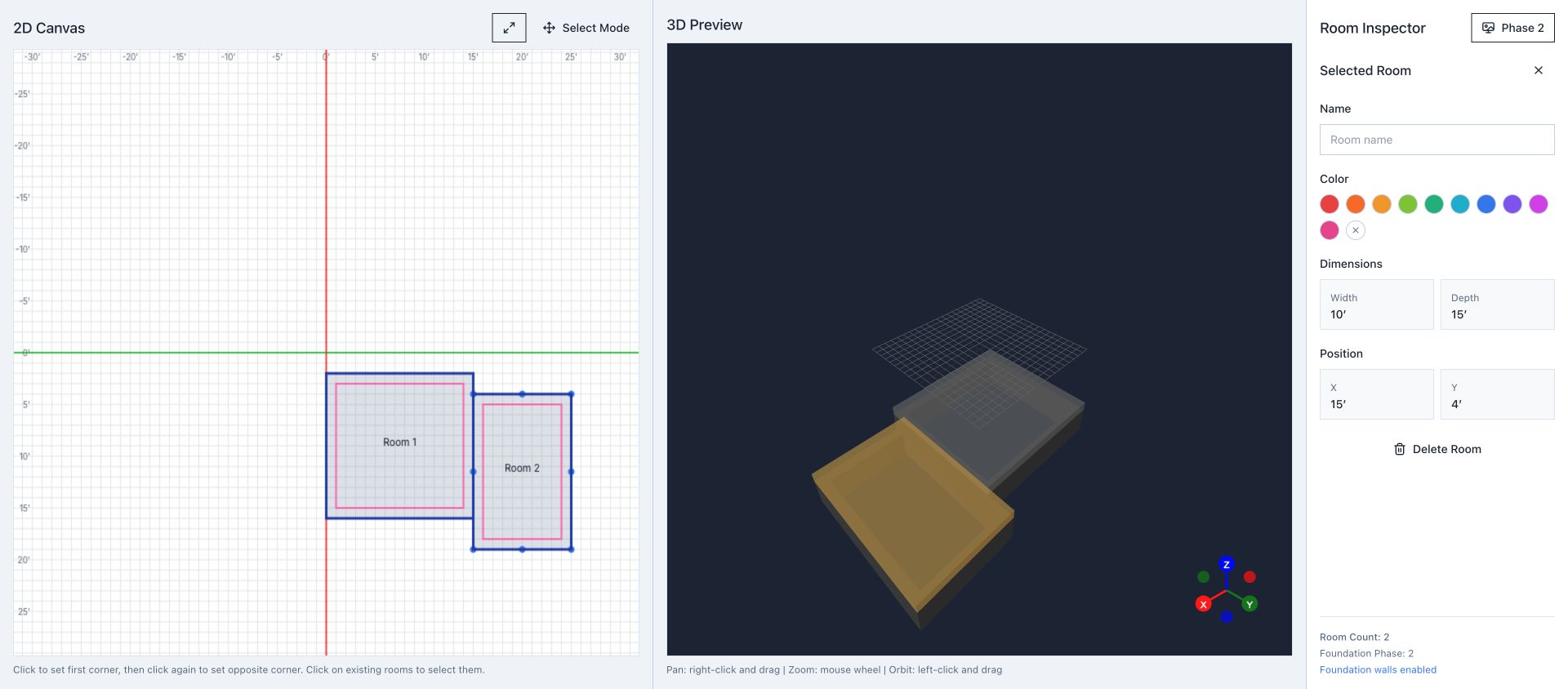
Compare the views
Foundation Merge Prototype places a 2D drawing canvas, a 3D preview, and a Room Inspector side by side. Rectangular rooms are the input. Drawing and moving them in plan provides a simple way to set up separated, adjacent, and overlapping arrangements while watching the corresponding slab and foundation geometry.
The inspector reports the selected room’s dimensions and position in feet. It also includes a name field, color choices, and a delete action. Selection is shared with the preview, where the selected slab is highlighted. The emphasis is on keeping an individual room identifiable as the surrounding arrangement changes.
Separate slab and foundation states
A Phase control switches between a slab-only state and a state that includes foundation walls. The second phase is the default. This provides a direct comparison between the horizontal footprint and the additional geometry below it, without changing the room layout to make that comparison.
The preview supports orbit, pan, and zoom, with an axis gizmo to clarify orientation. The plan uses an architectural grid and provides movement controls for selected rooms. The prototype’s input remains rectangular room footprints rather than arbitrary freeform building boundaries.
Keep the experiment honest
The source includes functions for room adjacency, limited overlap, combined perimeters, and union slabs. However, the active renderer currently processes each room as its own one-room group. Its multiple-room union branch is not reached by that grouping logic. The project should therefore be read as a foundation-behavior testbed, not as proof that all connected rooms are automatically merged into a single robust foundation.
That distinction defines what is useful to explore: make a small arrangement, compare its plan and spatial representations, change the foundation phase, and inspect individual rooms. The current implementation offers a concrete setting for those comparisons while leaving broader geometry-merging behavior as an area for further development.