CAD / Project story
Links Group Prototype
A small testbed for the boundary between linked content and local edits.
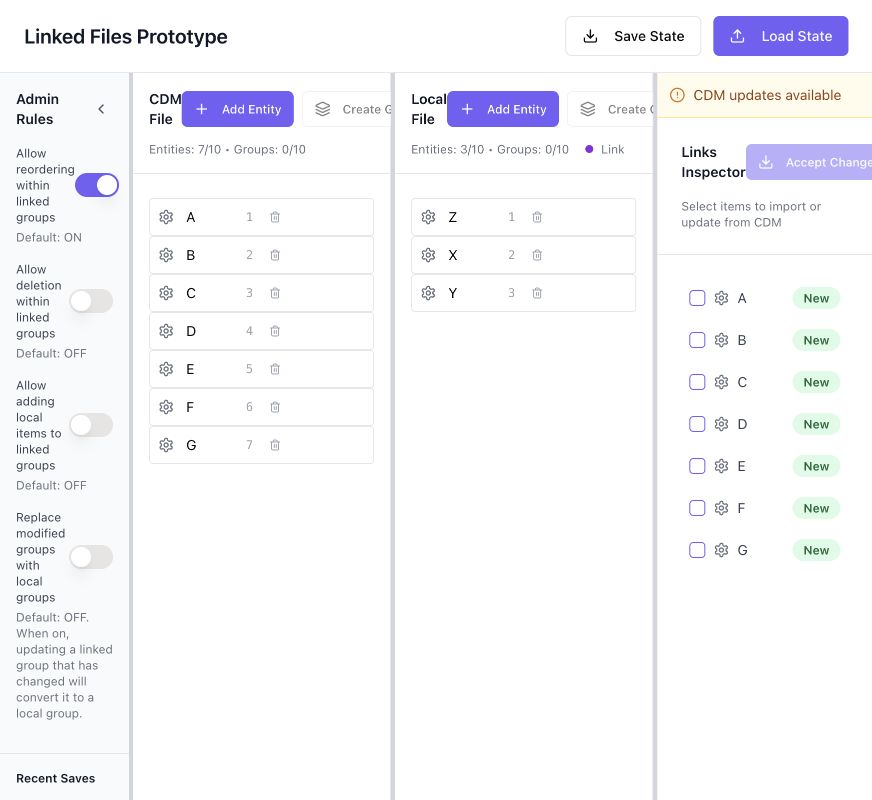
Two versions, side by side
The Links Group Prototype puts a source file and a local file next to each other. Each contains entities that can be named, selected, reordered, and collected into groups. A separate Links Inspector presents source items available to bring into the local file. This makes the relationship between the two collections visible instead of hiding it behind a single import command.
The source collection is simulated inside the application. It is a place to change the upstream example and observe what happens locally, rather than a connection to a live document-management service. Linked items keep a source identifier, while locally created items remain independent.
Rules become part of the interface
An Admin Rules panel exposes several choices that are often buried in linking behavior: whether users can reorder linked-group members, delete them, or insert local items. Another option changes how modified groups are handled when their source contents change. These switches let the same example be explored under different policies.
The local collection distinguishes linked, modified, update-available, and local-only states. Group updates map source members to their local counterparts, and importing a selected group avoids separately duplicating its selected children. When a source item disappears, the model supports deleting its local counterpart or keeping it as a local item.
Repeatable scenarios
Drag-and-drop targets distinguish placing an item before, after, or inside another item. Those small ordering decisions matter because a group has both membership and sequence, and a local sequence can diverge from the source.
Save and load controls preserve examples for comparison. Recent saves live in browser storage, with up to ten snapshots, and the state can be serialized as JSON. The result is a focused interaction prototype for examining update rules and local ownership, rather than a production file synchronization system.