Games / Project story
Marble Drift
Steer a marble through little worlds.
A race you steer
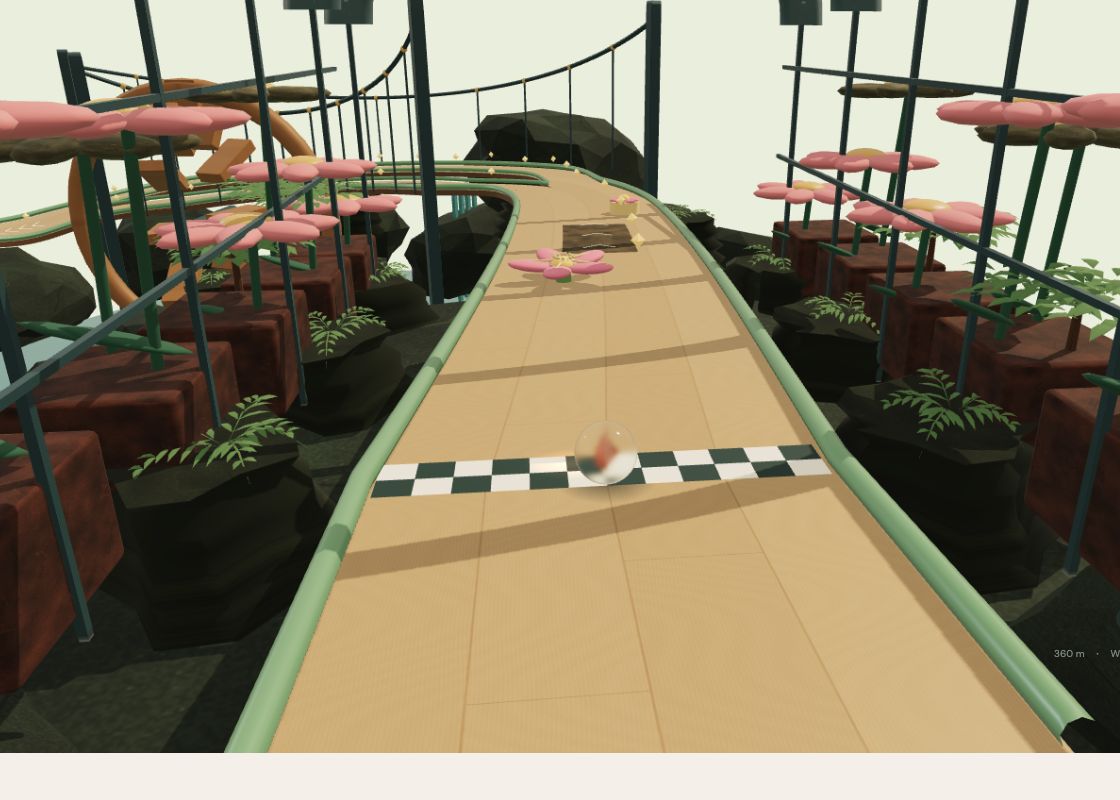
Marble Drift is a browser racing game with solo runs and shared race rooms. A player chooses a marble finish and a racing name, then steers along a three-dimensional course. Keyboard, touch, and device tilt offer different ways to make the same small corrections. Braking gives a way to trade speed for control when a bend or obstacle approaches.
The camera follows behind the marble, bringing the course close to the action. Materials, rolling rotation, shadows, and reflected light help communicate the ball as an object moving through a place. The marble collection changes its appearance while keeping the underlying physics the same.
Courses with different consequences
The source describes three course families: a garden, an iceway, and a volcanic ridge. Their obstacles and surfaces vary alongside the scenery. Garden rails provide an easier route, while exposed sections on other courses introduce the possibility of falling. A fall returns the marble to an earlier point at rest while the race clock keeps running.
That recovery rule makes the edge meaningful without ending the run. Ramps, bumps, braking, and rail openings all give steering a visible consequence. The project combines those movement rules with a low chase camera and themed scenery, so the experience includes both navigating the track and looking ahead through the world.
Sharing a start
A host can create a room and share its six-character code. Joined players receive a common countdown and race on the selected course. Room state, starts, and results are stored on the server; the marble movement itself is simulated in each browser and exchanged over the network. Other racers are interpolated between updates.
This is a casual multiplayer prototype. Network delay can affect finish ordering, and client-simulated movement is not an anti-cheat system. The development record also distinguishes browser-size checks from physical-device testing: iPhone and iPad motion sensors still need real-device verification. The prototype link is the place to try the current courses, choose a marble, and compare the input methods available on your device.