CAD / Project story
Unit Wall Detection
See how a boundary changes when rectangular units meet.
The edge is the subject
Unit Wall Detection is a small browser diagramming prototype for examining relationships between rectangular shapes. Draw a few units on the grid, move them into different arrangements, and inspect how their borders are classified. A visible legend identifies exterior, interior, and unit-to-unit conditions.
The drawing uses a deliberately limited vocabulary. Rectangles provide the space, a grid makes alignment visible, and colored border segments carry the result. Instead of hiding the classification behind a property panel, the prototype puts it directly on the boundary where two shapes meet.
Compare the conditions
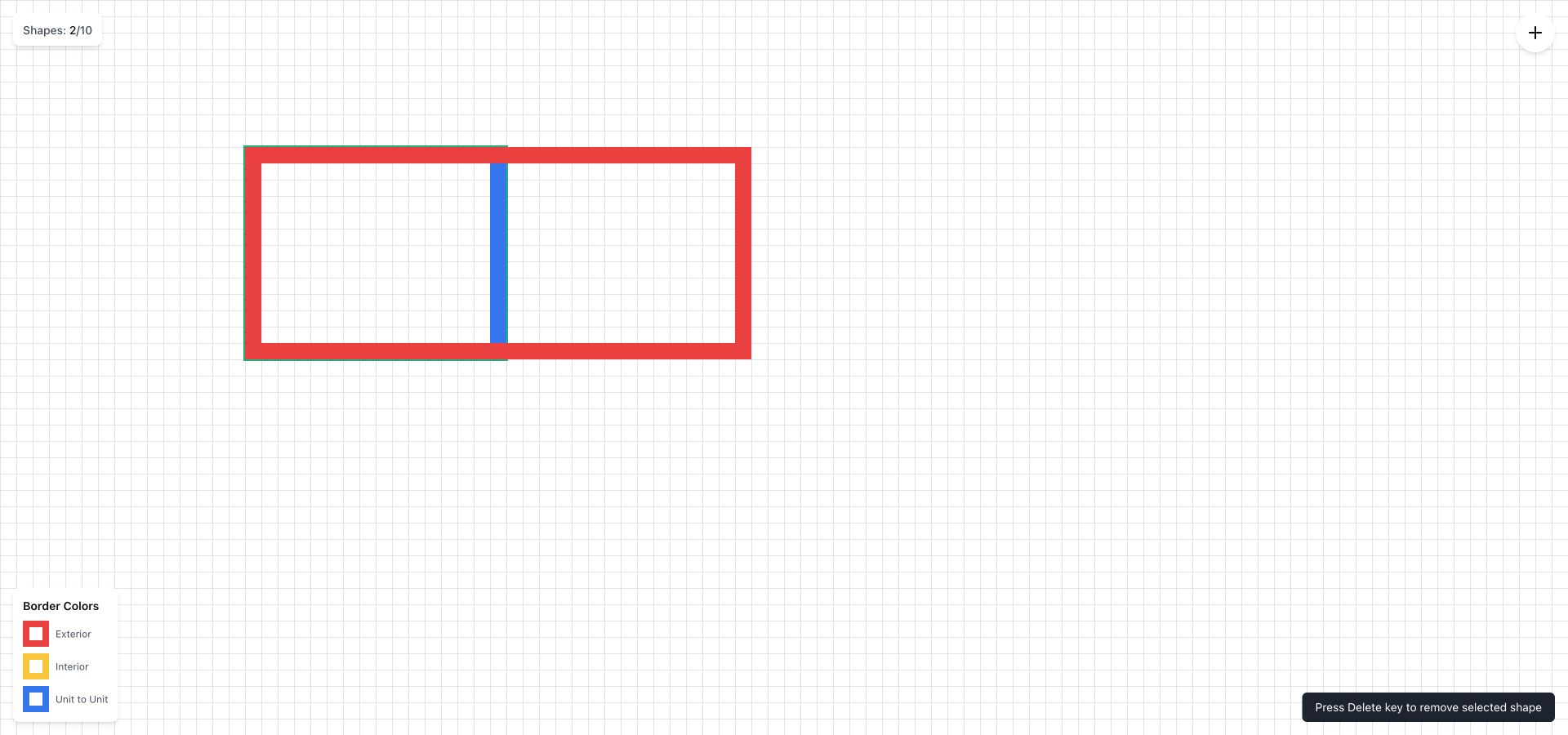
The recovered interface distinguishes exterior boundaries in red, interior conditions in yellow, and unit-to-unit overlap in blue. A shape can therefore participate in more than one condition along its perimeter. The important comparison is between the arrangement of the rectangles and the segments that change color.
Adding and deleting shapes makes it possible to rebuild an example quickly. The prototype limits the drawing to ten shapes, keeping the workspace small enough to inspect. A simple pair is a useful starting point: compare separation, contact, and overlap before adding a third shape that changes the relationship at a corner.
A recovered interaction study
This version restores an earlier working browser build of the project. Its focus is the boundary-classification interaction shown in the diagram. It is not a claim of complete BIM wall generation, construction detailing, or general-purpose geometric robustness.
The screenshot uses synthetic rectangles so the behavior can be read without a real building project. Open the prototype to make another arrangement and compare its borders against the legend. The value of this small study is that the rule and its visual consequence stay close together: changing a shape gives a concrete result to inspect, rather than a description of how wall relationships might work.